
✅Recently updated
Description
PenForensic: Academic Integrity Analysis for Educators
PenForensic is a Chrome extension that helps university and TAFE educators assess whether student submissions may contain AI-generated content. It is a decision-support tool designed to inform your professional judgement, not replace it.
PenForensic does not deliver verdicts. It provides forensic indicators backed by peer-reviewed research so you can make better-informed decisions while following your institution's academic integrity procedures.
HOW IT WORKS
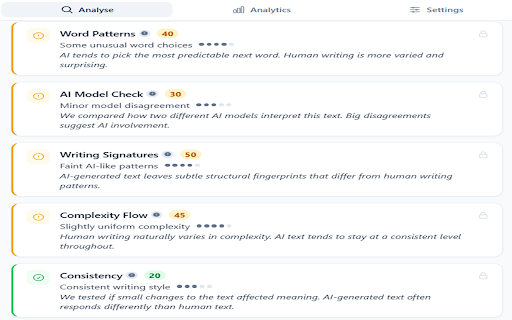
Open PenForensic from the Chrome side panel, select the student's academic level, paste the submission text, and run the analysis. The tool processes the text through 10 independent forensic markers running concurrently, then presents a structured report with an overall suspicion score, a confidence assessment, and detailed evidence for each marker.
You can optionally provide a sample of the student's known previous writing as a baseline. When a baseline is provided, PenForensic generates a Writing DNA comparison that measures how closely the submission matches the student's established writing style across 11 dimensions.
10 FORENSIC MARKERS GROUNDED IN PEER-REVIEWED RESEARCH
Every marker in PenForensic is grounded in published, peer-reviewed research. The full citations are displayed inside the extension so you can verify the research yourself.
1. Probability Curvature: Estimates whether the text sits at a probability maximum, a pattern characteristic of machine-generated content where small word changes cause disproportionate drops in fluency.
2. Dual Model Contrast: Evaluates text from two contrasting analytical perspectives, assessing naturalness versus originality. When text reads as highly natural but lacks originality, it may indicate AI generation patterns.
3. Generative Fingerprint: Tests whether prompting a language model with excerpts from the submission produces suspiciously similar continuations, and measures statistical bias toward high-frequency tokens.
4. Information Density: Measures how uniformly information is distributed across sentences. AI-generated text tends to maintain unnaturally consistent information density compared to human writing, which naturally varies in complexity.
5. Robustness and Benchmark: Tests whether AI signals persist after the text is paraphrased, and compares vocabulary and structural metrics against human versus AI reference distributions.
6. Intrinsic Dimensionality: Estimates the intrinsic dimensionality of the text's linguistic feature space. Human writing typically occupies a higher-dimensional manifold than AI-generated text, meaning humans use a more diverse combination of linguistic features.
7. Psycholinguistic Cognitive: Looks for traces of genuine cognitive processes in the writing, such as self-monitoring markers, uncertainty expressions, parenthetical asides, and natural variation in syntactic complexity.
8. Semantic Coherence Drift: Measures how topic similarity between sentences evolves across the text. Human writing naturally drifts in coherence as writers develop arguments and occasionally go on tangents before refocusing. AI text tends to maintain unnaturally steady coherence throughout.
9. Stylometric Fingerprint: Profiles the distribution of function words and part-of-speech patterns, then compares them against known AI writing profiles using statistical divergence measures.
10. Linguistic Error and Fairness: Identifies ESL error patterns such as article omission and agreement mismatches as signals of human authorship, because AI rarely produces these specific errors. This directly addresses the documented fairness problem in AI text detection, where non-native English speakers are disproportionately flagged by other tools.
CONFIDENCE AND TRANSPARENCY
PenForensic does not give you a single number and leave you to guess what it means.
Every analysis includes:
- A confidence tier (High Confidence, Moderate Confidence, Uncertain, or Insufficient Evidence) that tells you how much weight to place on the results.
- A marker agreement score showing what percentage of the 10 markers agree with each other. When markers disagree, the tool tells you.
- A false positive risk assessment (Low, Medium, or High) that warns you when the results are more likely to be inaccurate.
- Recommended next steps tailored to the confidence level, such as conducting a follow-up conversation with the student or requesting additional writing samples.
- An agreement breakdown showing exactly how many markers flagged concern, how many found no concern, and how many were uncertain.
SENTENCE-LEVEL HIGHLIGHTING
The evidence tab includes a heat map view that colour-codes every sentence in the submission based on individual suspicion signals. You can see exactly which sentences raised concerns and which appeared consistent with human writing. Each highlighted sentence shows the specific signals that triggered the score.
WRITING DNA COMPARISON
When you provide a baseline sample of the student's known writing, PenForensic builds a stylometric fingerprint for both the baseline and the submission, then compares them across 11 dimensions. The result is a match percentage with a visual breakdown showing where the two writing samples align and where they diverge. This helps you assess whether the submission sounds like the student who supposedly wrote it.
FOLLOW-UP QUESTION GENERATOR
PenForensic generates targeted follow-up questions you can use in a conversation with the student about their submission. Questions fall into three categories: conceptual depth questions that test understanding, source verification questions that probe knowledge of references, and counter-argument questions that assess critical thinking. Each question includes a rationale explaining why it was generated and a copy button for easy use.
STUDENT DATA PROTECTION
PenForensic automatically strips personally identifiable information before any text is sent for analysis. This includes email addresses, phone numbers (Australian, US, UK, and international formats), student ID numbers, URLs, and name headers. Each analysis is assigned an anonymous case ID. The anonymisation badge shows you exactly how many items were redacted and what types of personal information were removed.
YEAR-LEVEL CALIBRATION
You select the student's academic level before running an analysis. Options include Certificate III/IV, Diploma, Undergraduate Years 1-2, Undergraduate Years 3-4, and Postgraduate. The analysis adjusts its expectations based on the selected level, because what looks suspicious in a postgraduate thesis may be perfectly normal in a Certificate III assignment.
PDF REPORT EXPORT
Export a complete analysis report as a professionally formatted PDF document. The report includes the overall score, confidence assessment, all marker results, and the evidence breakdown. This creates a documented record you can attach to academic integrity proceedings or keep in your files.
ANALYSIS HISTORY
PenForensic stores your last 50 analyses locally in Chrome's storage. You can revisit previous results without rerunning the analysis. History is stored entirely on your device and is never sent to any server.
REPRODUCIBLE RESULTS
If you analyse the same text twice with the same year level, you will get the same results. PenForensic uses deterministic processing and caches results by content hash. Your findings are consistent and defensible.
FREE AND PRO TIERS
The free tier includes 5 analyses per month with access to the overall score, marker scores, and confidence assessment. The Pro tier unlocks unlimited analyses plus sentence-level highlighting, Writing DNA comparison, PDF report export, follow-up question generation, student communication notices, research citations, learning insights, class analytics, and custom detection thresholds.
WHAT PENFORENSIC IS NOT
PenForensic is not a plagiarism checker. It does not compare submissions against a database of existing documents. It is not a certainty engine. No AI detection tool can tell you with absolute certainty whether a piece of text was written by a human or generated by AI. PenForensic provides indicators and evidence to support your professional judgement. The safeguard banner in the interface reminds you to always follow your institution's academic integrity procedures.
TECHNICAL DETAILS
PenForensic runs as a Chrome side panel extension. It requires only two permissions: side panel access and local storage. Six of the ten markers run entirely locally using natural language processing without any external API calls. The remaining four use language model analysis for deeper assessment. All processing is done per analysis with no data retained on servers after the response is returned.



Reviews
Loading reviews...
Permissions (2)
Permissions
sidePanel storageℹ Can store data locally in your browser
Details
| Version | 1.1.0 |
| Updated | Feb 24, 2026 |
| Size | 350KiB |
| First Seen | Mar 23, 2026 |
Popular in education

Kami for Google Chrome™
by Kami
17M
★ 4.56
education
17M
★ 4.56
education

Language Reactor
by Dioco
2M
★ 4.20
education
2M
★ 4.20
education

Speechify — Text to Speech
by Speechify
1M
★ 4.59
education
1M
★ 4.59
education

LibKey Nomad
by Third Iron LLC
1M
★ 4.71
education
1M
★ 4.71
education

xFanatical Safe Doc
by xFanatical
700K
★ 1.46
education
700K
★ 1.46
education
Popular Extensions

Adobe Acrobat: PDF edit, convert, sign tools
by Adobe Inc.
330M
★ 4.40
workflow
330M
★ 4.40
workflow

Chrome Remote Desktop
by Chrome Remote Desktop Release Managers
38M
★ 3.14
workflow
38M
★ 3.14
workflow

Cisco Webex Extension
by cisco.chromestore
24M
★ 2.34
social
24M
★ 2.34
social
Kami for Google Chrome™
by Kami
17M
★ 4.56
education
17M
★ 4.56
education

Read&Write for Google Chrome™
by Texthelp
17M
★ 3.44
accessibility
17M
★ 3.44
accessibility